
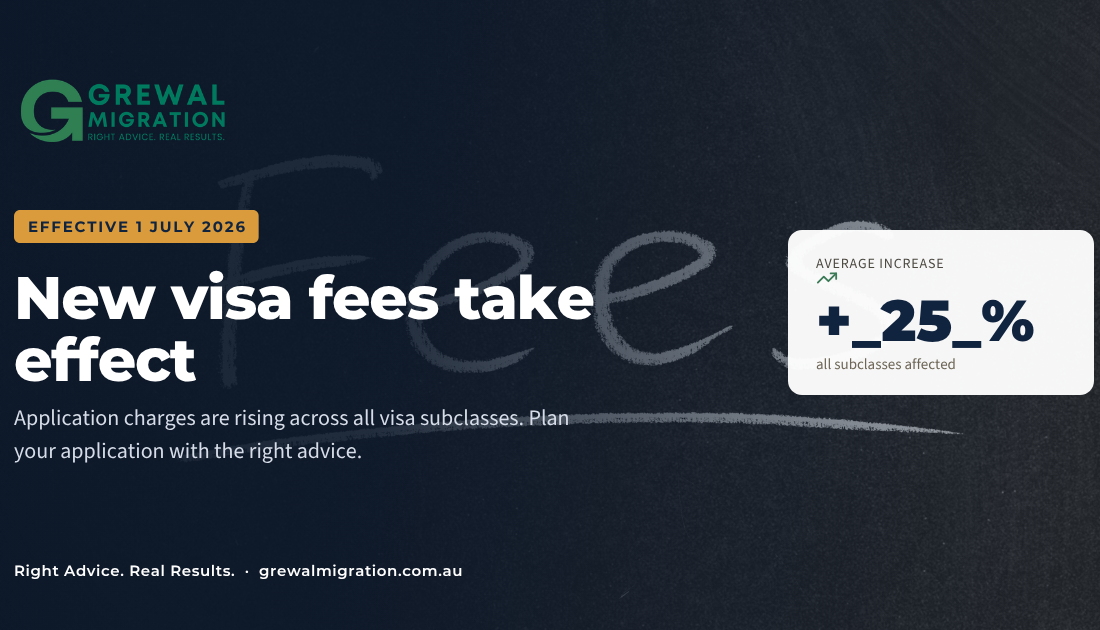
From today, most Australian visa applications cost about 25% more to lodge. But a new lower rate could save some applicants thousands. Here’s the plain-English version of what changed.
On 1 July 2026 a new regulation — the Home Affairs Legislation Amendment (2026 Measures No. 1) Regulations 2026 — changed what you pay to lodge most Australian visa applications. For most people, the first-instalment Base Application Charge rose by roughly a quarter overnight. If you’ve been weighing up a skilled, partner, parent or employer-sponsored application, the cost of waiting just went up.
There’s also a genuinely new feature in this update: a two-tier pricing system that charges some applicants far less than others. Below we break down what moved, by how much, and what we’d advise if you’re planning an application this year.
The headline: most visas now cost about 25% more
Across almost every permanent and provisional visa, the 2026 “Standard” charge is the old 2025 rate multiplied by about 1.25 — a flat 25% increase, rounded to the nearest $5. This is not the usual small CPI indexation we see each July; it’s a deliberate, program-wide jump.
To put it in real numbers: the Subclass 189 Skilled Independent visa moved from $4,910 to $6,135 for a primary applicant — an extra $1,225 before you add a single family member. Additional-applicant charges rose by the same proportion, so a family of four feels this increase four times over.
The new part: a two-tier “Pacific” rate
For the first time, the price you pay depends on the passport you hold. The same instrument created a lower “Pacific” rate for applicants who hold a valid passport from a Pacific-regional country. If that’s you, your charge rose by CPI only — roughly 2.5% — instead of 25%.
In practice, a Pacific applicant now pays about 82% of the Standard rate — roughly 22% less. On a partner visa, that’s the difference between $11,710 and $9,600 — more than $2,000 back in your pocket. If you hold one of these passports, it’s worth confirming before you lodge.
Federated States of Micronesia · Fiji · Kiribati · Nauru · Palau · Papua New Guinea · Marshall Islands · Samoa · Solomon Islands · Timor-Leste · Tonga · Tuvalu · Vanuatu
What the popular visas now cost
These are the first-instalment Base Application Charges for the primary applicant. Add the relevant additional-applicant charges for each partner or child you include.
| Visa | 2025 | 2026 Standard | 2026 Pacific |
|---|---|---|---|
| Subclass 189 — Skilled Independent | $4,910 | $6,135 | $5,030 |
| Subclass 190 — Skilled Nominated | $4,910 | $6,140 | $5,035 |
| Subclass 491 — Skilled Work Regional (Prov) | $4,910 | $6,140 | $5,035 |
| Subclass 186 — Employer Nomination | $4,910 | $6,140 | $5,035 |
| Subclass 485 — Temporary Graduate (tiers restructured) | — | $5,750 | $930 |
| Partner (onshore) — 820/801 | $9,365 | $11,710 | $9,600 |
| Partner (offshore) — 309/100 | $9,365 | $11,710 | $9,600 |
| Subclass 103 — Parent | $5,280 | $6,600 | $5,410 |
| Subclass 143 — Contributory Parent (+ VAC2) | $5,040 | $6,300 | $5,170 |
| Subclass 864 — Contributory Aged Parent (+ VAC2) | $5,040 | $6,300 | $5,170 |
| Subclass 500 — Student (no Pacific tier) | $2,000 | $2,500 | — |
Headline first-instalment base charges for the primary applicant. Contributory Parent visas (143, 864) also carry a large second instalment (VAC2) of roughly $43,600 per adult, set separately. Subclass 485 was restructured into four tiers, so a clean 2025 comparison isn’t available — the $930 Pacific and $5,750 standard rates are shown. Some subclasses have concessional sub-tiers (orphan relative, carer, prior-visa holders) we’ll confirm for your specific case.
A few fees more than doubled
Not everything followed the neat 25% rule. A handful of charges jumped far more steeply:
- Return (Residence) — 155/157: the Standard rate roughly tripled, from $490 to $1,475.
- Bridging B (BVB): also about 3×, from $190 to $575 for Standard applicants.
- Subclass 500 Student: up 25% again — on top of a 25% rise the year before, so it has effectively risen by more than half across two years.
For these, the Pacific rate still tracks CPI — Return (Residence) Pacific is just $505 — so the gap between the two tiers is dramatic.
Citizenship barely moved
If you’re applying for citizenship rather than a visa, there’s good news: those fees rose only modestly. Citizenship by conferral went from $370 to $380 (about 3%), and the concessional rate for eligible low-income and aged-pension applicants moved from $150 to $160. Evidence of citizenship and descent applications saw similar small rises. Unlike the visa charges, citizenship costs were indexed gently, not stepped up.
One more change: a new income floor for employers
The same instrument set a Temporary Skilled Migration Income Threshold (TSMIT) of $79,423. This isn’t an application fee — it’s the minimum salary an employer must offer to sponsor a worker, and it applies to nominations made on or after 1 July 2026 (indexed annually from July 2027). If you’re an employer-sponsored applicant, your nominated salary needs to sit at or above this floor.
If you’re planning to apply, timing and accuracy matter more than ever
A 25% jump — or a tripling, on some visas — turns a delayed application into a real, avoidable cost. Three things we’d check with you straight away:
- Whether you qualify for the lower Pacific rate — it can save thousands.
- Whether lodging sooner avoids a further indexation step, and that your documents are ready so we lodge it right the first time.
- Whether any concessional sub-tier applies to your case — many do, and they’re easy to miss.
Current charges: Home Affairs Legislation Amendment (2026 Measures No. 1) Regulations 2026 (F2026L00874), commenced 1 July 2026. Previous charges: F2025L00796, in force 1 July 2025–30 June 2026.
All figures are first-instalment Base Application Charges for the primary applicant and may include rounding. Second-instalment (VAC2) charges — which dominate the cost of contributory parent visas — are set separately and are not shown here. This is general information, not legal advice; we’ll confirm the exact charges for your situation before you lodge.
Grewal Migration — Right Advice. Real Results.